What does Industrie 4.0 mean – and what role does sensor technology play in it?
Industrie 4.0 represents the next major step in the development of industrial production – after mechanization, electrification and automation, manufacturing systems are now being digitalized and networked. Machines, systems and products are interconnected, exchange data in real time and increasingly make decisions independently. The goal: intelligent, flexible and efficient production processes that automatically adapt to changing requirements. However, digitalization does not start in the cloud, but at the beginning of the value chain – at the sensor.
Industrie 4.0 is a living reality - and starts with intelligent sensors.
Sensors – the sensory organs of Industrie 4.0
Sensors are the basis of every smart factory. They record physical variables such as distance, color, pressure or movement and convert them into digital information. Only with this data can a machine “understand” what is happening in its environment and react to it.
“Sensors are the eyes and ears of networked production. They provide the basic information on which modern automation, AI models and process optimization can be built in the first place. Without them, Industrie 4.0 would only be a concept – not a functioning system.”
From sensors to networked intelligence
Communication via IO-Link
A core element of Industrie 4.0 is bidirectional communication. With IO-Link-capable sensors from wenglor, not only can measurement data be transmitted, but device settings and diagnostics can also be carried out remotely. This reduces set-up times, facilitates maintenance and ensures complete transparency about the status of all sensors in the network.
Smart Cameras and Machine Vision
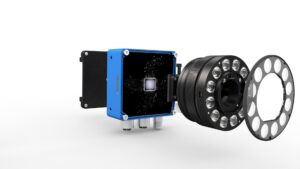
While classic sensors deliver measured values, Smart Cameras and Vision Sensors analyze complex data directly in the device. The Smart Camera B60, for example, uses deep learning algorithms for object detection, text capture and quality inspection – without a separate analysis module. This makes image processing an integral part of intelligent manufacturing and makes a decisive contribution to quality, traceability and efficiency.
Precision for digital twins
Using laser distance sensors and 3D sensors, wenglor captures geometries and distances down to the micrometre range. This high-precision data serves as the basis for digital twins – virtual images of real processes or systems that enable simulations, predictive maintenance and process optimization.
Data intelligence meets robustness
For Industrie 4.0 to work, sensors must also work reliably in demanding environments. wenglor sensors are designed for this: resistant to dirt, vibrations and temperature fluctuations, with consistently high precision. This means that processes remain stable, safe and reproducible even under real industrial conditions.
Conclusion: The future of industry is networked – and starts with the sensor
Industrie 4.0 is no longer a vision of the future, but a living reality – and it doesn’t start with software, but with sensors. Sensors make machines alert, systems adaptive and processes intelligent.
With innovative solutions such as IO-Link sensors, Smart Cameras and Vision Sensors, wenglor provides the basis for the factory of the future: a production that thinks, communicates and optimizes itself – from the real world to the cloud.
To provide you with an optimal experience, we use technologies such as cookies to store and/or access device information. If you consent to these technologies, we may process data such as browsing behaviour or unique IDs on this website. If you do not give your consent or withdraw it, certain features and functions may be affected.
Functional
Always active
Technical storage or access is strictly necessary for the legitimate purpose of enabling the use of a specific service explicitly requested by the subscriber or user, or for the sole purpose of carrying out the transmission of a communication over an electronic communications network.
Preferences
Technical storage or access is necessary for the legitimate purpose of storing preferences that have not been requested by the subscriber or user.
Statistiken
Technical storage or access for statistical purposes only.Technical storage or access used exclusively for anonymous statistical purposes. Without a subpoena, the voluntary consent of your internet service provider, or additional records from third parties, the information stored or accessed for this purpose cannot, as a rule, be used to identify you.
Marketing
Technical storage or access is required to create user profiles, send advertising or track users on a website or across multiple websites for similar marketing purposes.