What are the advantages of using AI in quality control?
Industrial quality control is undergoing radical change. While rule-based image processing systems or manual visual inspections have been common practice for decades, the use of artificial intelligence (AI) is opening up completely new possibilities. AI-based processes are revolutionizing industrial image processing and making production processes more efficient, robust and cost-effective.
AI-supported image processing systems offer decisive advantages.
How AI supports production processes
Classic image processing systems work with fixed rules and algorithms. This works well as long as the processes are highly standardized and only minimal deviations occur. In reality, however, things are often different: materials vary in color and structure, production environments change, for example due to changing lighting conditions, and products show natural differences in shape, surface or texture. As soon as this variance increases, conventional systems reach their limits. They tend to incorrectly reject parts that are actually flawless, known as pseudo rejects, or fail to detect faulty parts, a phenomenon known as slippage.
The result: increased costs, inefficient processes and, in the worst case, quality problems for the end customer. AI systems provide a remedy here: they tolerate natural variations and recognize deviations flexibly. They thus combine the strengths of human visual inspection – such as flexibility and contextual understanding – with the speed and repetition accuracy of computer-aided systems.
What actually is AI?
Artificial intelligence (AI) is the generic term for technologies that enable machines to solve tasks independently – often inspired by human thinking.
Machine learning: Systems learn patterns and correlations directly from sample data. Instead of defining each rule manually, the system itself “recognizes” how inputs are translated into outputs.
Deep learning: A specialized form of machine learning based on neural networks with many layers. This architecture makes it possible to recognize even very complex patterns and deliver precise results even under varying conditions.
The special feature: AI systems adapt, improve with each data set and can therefore also be used reliably and future-proof in dynamic production environments.
How AI optimizes quality control
Although rule-based systems are available, quality control is still carried out manually in many branches of industry. The reasons for this are the high variance of possible defect patterns and the limits of human attention. AI-supported image processing systems offer decisive advantages here: they ensure consistent and repeatable assessment based on large data sets, which significantly increases the quality of decisions. At the same time, they work around the clock without fatigue, which exceeds human attention spans. The results are documented automatically: images are saved, heat maps are created and score values are calculated so that decisions can be tracked and traced at any time. In addition, AI systems can be used and scaled independently of staff availability. Thanks to their intuitive operation, training requirements are significantly reduced, saving companies time and money while increasing process reliability.
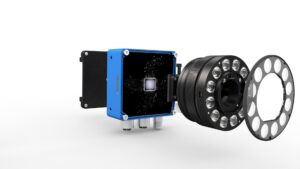
wenglor B60 Machine Vision Smart Camera Quality control of injection molded parts
Focus on economic benefits
The use of AI is not only a technological advance, but also an economic advantage:
Fewer pseudo rejects: good parts remain in the process, resources are conserved and productivity increases.
Less slippage: Defective parts are detected early and removed from the process – this reduces reworking, recall risks and complaints.
Greater efficiency: AI can evaluate large volumes of data in real time, recognize patterns and thus also serve as an early warning system.
Fast ROI: Investments in AI systems often pay for themselves in a short time thanks to fewer rejects, lower personnel costs and greater process reliability.
AI offers decisive competitive advantages
The use of AI in quality control provides companies with decisive competitive advantages. It enables greater accuracy and process reliability, reduces costs by minimizing waste and frees up skilled workers while increasing process efficiency. In addition, AI can be seamlessly integrated into the networked factory of the future. As a result, quality control is evolving from a mere “necessary checkpoint” into a strategic value driver of Industrie 4.0. Companies that rely on AI at an early stage not only secure a technological advantage, but also create the basis for sustainable growth in an increasingly variant-rich and data-driven production world.
wenglor B60 Smart Camera Quality control of injection molded parts
To provide you with an optimal experience, we use technologies such as cookies to store and/or access device information. If you consent to these technologies, we may process data such as browsing behaviour or unique IDs on this website. If you do not give your consent or withdraw it, certain features and functions may be affected.
Functional
Always active
Technical storage or access is strictly necessary for the legitimate purpose of enabling the use of a specific service explicitly requested by the subscriber or user, or for the sole purpose of carrying out the transmission of a communication over an electronic communications network.
Preferences
Technical storage or access is necessary for the legitimate purpose of storing preferences that have not been requested by the subscriber or user.
Statistiken
Technical storage or access for statistical purposes only.Technical storage or access used exclusively for anonymous statistical purposes. Without a subpoena, the voluntary consent of your internet service provider, or additional records from third parties, the information stored or accessed for this purpose cannot, as a rule, be used to identify you.
Marketing
Technical storage or access is required to create user profiles, send advertising or track users on a website or across multiple websites for similar marketing purposes.