How can I automatically read images from a display and process them digitally without external software?

In many industrial applications, it is necessary to automatically capture display values from devices – such as 7-segment displays, LCDs or digital measuring displays – and process them digitally. The aim is to reliably read out the value without the need for separate PC software or manual intervention. But how can this be achieved?

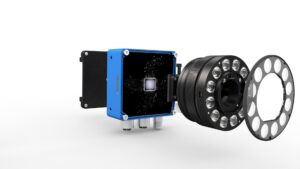
wenglor Smart Camera B60 and weQube - the Smart Camera B50 in the product overview image.
Smart Camera B60 and weQube+ B50 from wenglor - powerful image processing solutions for a wide range of industrial applications.

Automatic text recognition with wenglor Smart Cameras

The answer lies in intelligent image processing:
With wenglor’s Smart Cameras, for example the B50 or B60 models, numerical indicators can be automatically recorded, evaluated using the integrated OCR (Optical Character Recognition) function and output directly via an interface.

This allows a display value – such as a temperature, pressure or production figure – to be recorded, interpreted and passed on to a control system completely automatically.

B50 or B60 – two solutions, one goal

Smart Camera B50 – compact and cost-efficient

The Smart Camera B50 is ideal for compact applications with limited installation space. It offers precise OCR functions to recognize numbers and characters on displays or labels and impresses with its attractive price-performance ratio. Parameterization is conveniently carried out via the uniVision software, which offers an intuitive user interface for setup and evaluation.

Typical application:

  • Presence check of best-before dates (BBD) on food packaging
    In the packaging industry, the B50 checks above the conveyor belt whether the BBD is printed. At belt speeds of over one meter per second, it reliably detects whether the date is present – regardless of slight deviations in position.

Smart Camera B60 – AI-based OCR for maximum precision

The Smart Camera B60 goes one step further:
It uses an AI-based Deep OCR algorithm that has been trained on an extensive database. This means that the font does not have to be taught in manually. As a result, the camera recognizes even difficult fonts, varying print qualities or distorted characters reliably and quickly – ideal for dynamic production environments.

Typical application:

  • Checking best-before dates with Deep OCR
    When checking best-before dates on food packaging, the B60 reads the printed date precisely – even on glossy or slightly corrugated surfaces. Combined with domes and dome lights and vertical mounting above the conveyor line, it achieves reliable results at high belt speeds.

Simple integration into the system

Both camera systems work completely autonomously – no external PC software is required.
Image capture, text recognition and data output take place directly in the device.
The detected values can be output via Device TCP/IP or optionally RS-232 and thus seamlessly integrated into higher-level systems – such as a PLC or a data management system.

Conclusion: Autonomous text recognition made easy

With the B50 and B60 smart cameras from wenglor, indicators such as 7-segment displays or label imprints can be automatically captured, evaluated using OCR and digitally processed – without any external software.
The integrated intelligence, flexible interfaces and powerful algorithms make both models an ideal solution for a wide range of industrial applications – from the food industry to quality control in electronics manufacturing.

Tip from the expert: Anyone who needs to capture frequently changing fonts or variable print qualities will benefit from the AI-based Deep OCR technology of the Smart Camera B60. For compact applications with clearly defined font patterns, the B50 is an economical alternative with high reliability.

Author

Picture of Max Mustermann

Max Mustermann

Job title